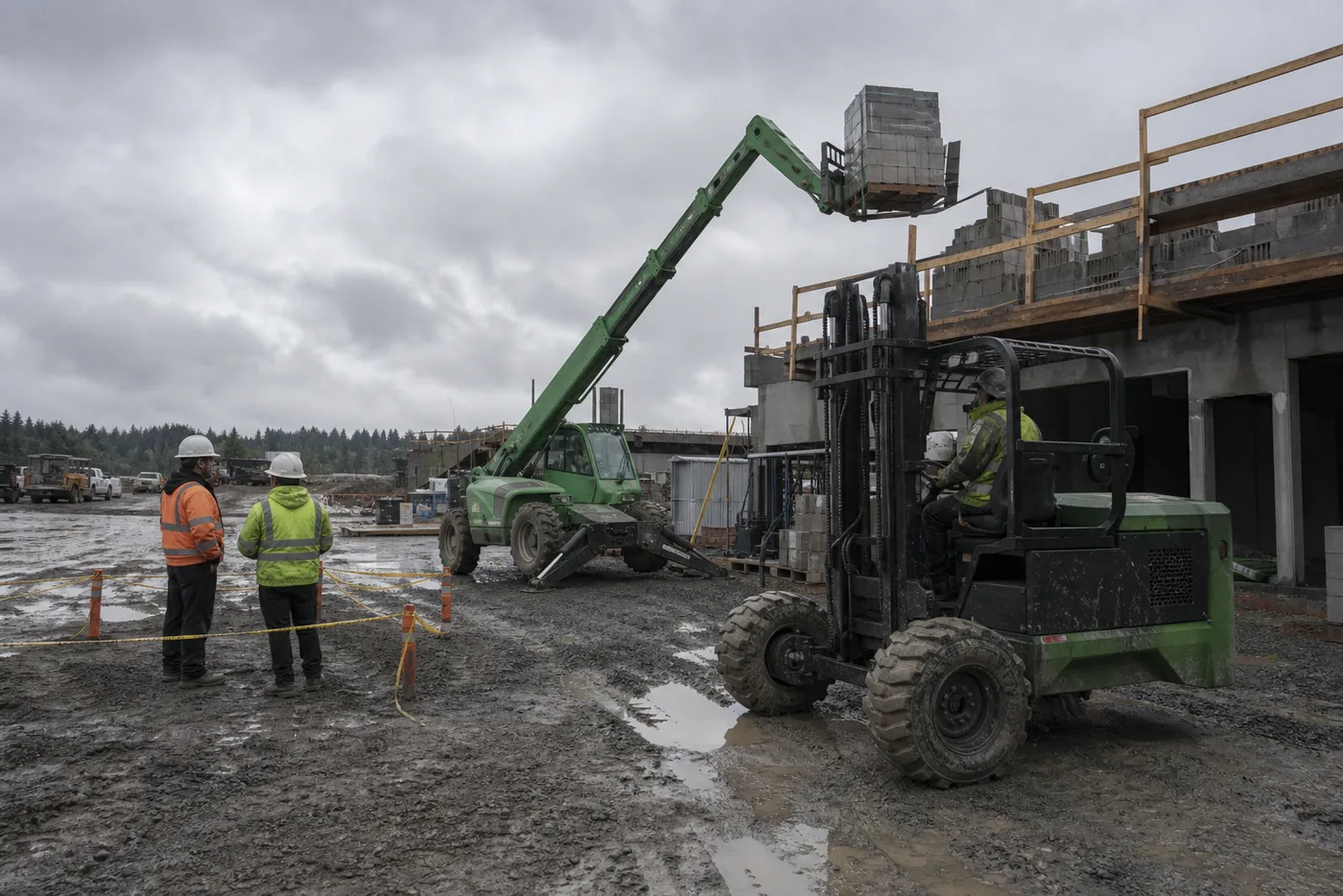
Telehandlers and rough-terrain vertical-mast forklifts can both move materials on uneven jobsites, but they solve different placement problems. A telehandler’s extending boom changes reach and capacity; a vertical mast follows a more direct lift path.
Define where the machine will stand, where the load begins and where it must be placed. Then compare the rough-terrain forklift configuration and telehandler requirements against actual site drawings.
Choose by load path, not equipment name
A load that must move forward and over an obstruction may call for telescopic reach. Repetitive vertical stacking from a firm approach may favor a rough-terrain mast truck. Record weight, dimensions, pickup elevation, placement height, forward reach and required attachment.
Capacity changes through the working envelope
Telehandler capacity varies with boom extension, angle, attachment and stabilization. Familiar machines such as JLG and SkyTrak telehandlers or a Genie GTH-844 each have their own working envelope; JLG’s 519 compact telehandler and high-capacity 1644 solve very different lifts. A machine’s maximum headline capacity may not apply at the required reach. Use the load chart for the exact configuration.
Ground conditions control the plan
Soil bearing, mud, slope, debris, trenches and changing weather affect access and stability. Walk the travel and setup route before delivery. Confirm surface preparation, exclusion zones and whether outriggers or stabilizers can be deployed as required.
Attachments must be approved
Fork carriages, buckets, truss booms and platforms change machine behavior and rating. Use only approved attachments with the appropriate chart and controls. An attachment that physically connects is not automatically safe or rated for the task.
Delivery and site logistics matter
Confirm transport dimensions, unloading area, gates, overhead lines, work-zone traffic and daily inspection responsibility. For a defined project, construction forklift rental can align equipment duration with the phase instead of carrying a specialized asset between jobs.
Jobsite equipment information
- Load weight, dimensions and center of gravity.
- Pickup point, placement height and forward reach.
- Ground bearing, slope and weather exposure.
- Approved attachment and load chart.
- Delivery route, unloading area and overhead hazards.
Frequently asked questions
Is a telehandler a forklift?
It is a variable-reach material handler with forks and other approved attachments; its load chart and operating method differ from a conventional forklift.
Can a telehandler lift at full capacity when extended?
Usually not. Capacity depends on boom angle, extension, attachment and configuration.
What tires are used on rough-terrain forklifts?
Application-specific pneumatic or foam-filled options are common; surface, puncture risk and manufacturer guidance matter.
Should I rent jobsite equipment?
Rental is often practical for defined phases, changing capacity needs or specialized reach.
Share the lift and site plan through Steele Forklift’s jobsite equipment request before selecting a machine.